

 12. September 2024
 Transitioning to Green Gases: Challenges and Solutions in Compressor Cooling Systems
Global Warming Potential (GWP) of Refrigerant Gases
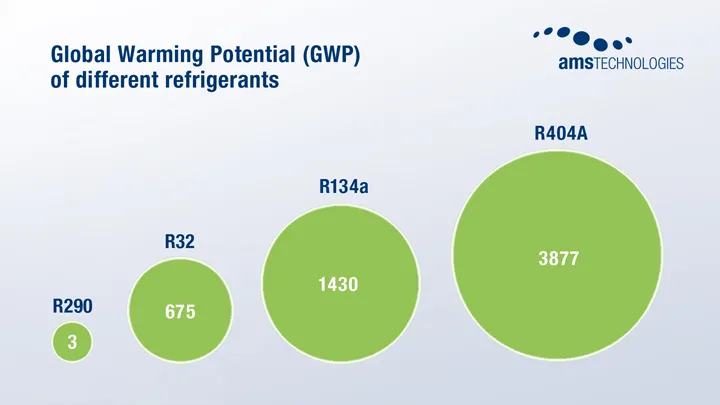
The Global Warming Potential (GWP) is the most important metric when discussing the environmental impact of refrigerant gases. It is defined as the heat absorbed by any greenhouse gas in the atmosphere, as a multiple of the heat that would be absorbed by the same mass of carbon dioxide (CO2). So, the GWP of CO2 is 1. The Carbon dioxide equivalent (CO2eq) is calculated from GWP and the mass of the other gas using the following formula:
CO2eq=GWP∙M
This calculation of CO2eq is particularly relevant when considering the history of refrigerants and their environmental impact.
From Natural to Synthetic Refrigerants – and Back
The first cooling compressors used natural refrigerant gases, primarily ammonia and carbon dioxide. However, due to safety concerns, the industry transitioned to chlorofluorocarbons (CFCs) and hydrochlorofluorocarbons (HCFCs). These gases were safer to handle and performed well, but they were found to deplete the earth’s ozone layer. The Montreal Protocol, adopted in 1987, highlighted the environmental damage these gases caused and initiated a phasedown of CFCs. This led to a rise of hydrofluorocarbons (HFCs) – which, while not ozone-depleting, were still potent greenhouse gases with a very high GWP.
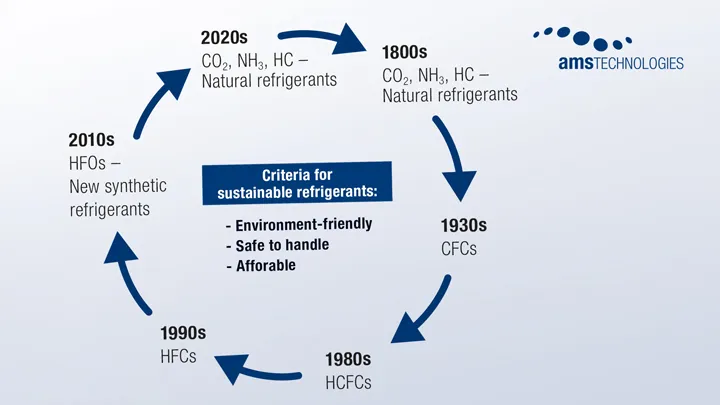
The EU F-Gas Regulation, in line with the global climate goals set by the Paris Agreement of 2015, mandates a shift to refrigerants with a low GWP, including A2L refrigerants. The regulation includes the phasedown of HFCs and specific prohibitions on high-GWP refrigerants. This is part of a broader effort to mitigate the impact of refrigerants on climate change.
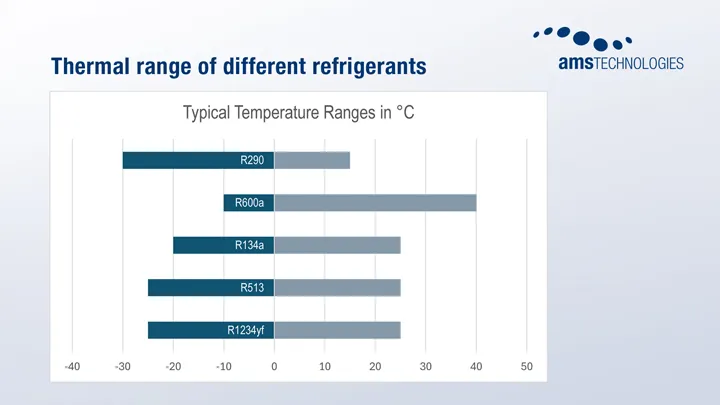
In practice, this means that from January 2027 onwards, newly purchased compressor cooling systems need to be equipped with green refrigerants. In many cases, manufacturers are reverting back to natural refrigerants, such as CO2, NH3, or HC. This, in turn brings new challenges. For one part, the temperature range and cooling efficiency of refrigerants differs significantly, requiring adjustments in the system design. Also, many green refrigerants require additional safety measures or adaptions of materials in the compressor circuits – for example propane with high flammability or ammonia with high corrosiveness.
Key Technologies for Compressor Cooling with Green Gases
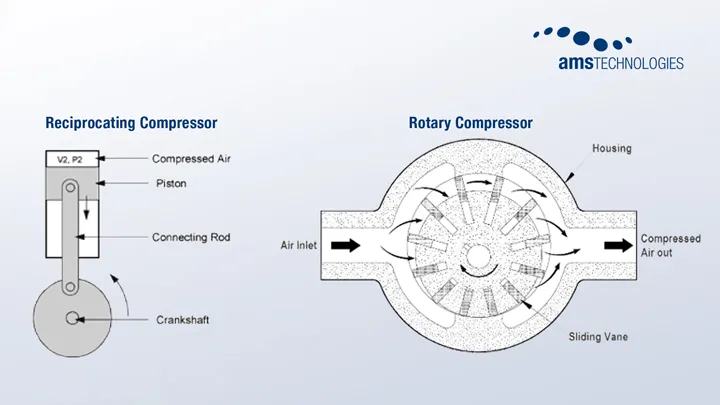
To manage the switch to green gases, the market for laser cooling is still exploring to find the best solution. Following the clear timeline for the transition defined by European legislation, compressor manufacturers are expanding their portfolios now. However, as the European market makes only a small share of the global sales, this is taking time. AMS Technologies is mainly working with two technologies – reciprocating compressors and mini rotary compressors. Reciprocating compressors are readily available with green gases, as they had to move to isobutane and propane more than 20 years ago for applications like refrigeration in household and supermarkets. Some of these compressors are also suitable for high back pressure applications, such as recirculating chillers for laser cooling with a capacity of up to 800 W. As in a fridge, they feature very low noise levels. Mini rotary compressors on the other hand have been around for more than 10 years but were originally designed for R134a. Some of them are already suitable for propane and some models are just being launched from the bigger compressor manufacturers. For noise and vibration twin pump models are preferrable.
Combining Compactness and Sustainability
Space restrictions do not only apply when the cooling circuit is integrated into a larger system. In laboratories and other applications space is limited as well, so between two comparable systems the more compact one usually has the edge. For those reasons, AMS is striving to make the systems as compact as feasible.
The size is mostly determined by the dimensions of the condenser, the compressor itself and the evaporator. Microchannel heat exchangers typically have only half the depth of an equivalent finned 5 mm tube heat exchanger and thus can help to make systems more compact. Brazed plate heat exchangers are state of the art in many applications, but for compact liquid cooling kits most of the modules on the market are too big (200 mm x 75 mm plates), especially for small systems where they can become an oil trap. Fortunately, there is one manufacturer that offers a very compact brazed plate heat exchanger with 133 mm x 38 mm plates as an alternative. While most reciprocating compressors are big and heavy, a low-profile model is available with only 115 mm height and a footprint of 150 x 200 mm including inverter. Twin pump rotary compressors are usually somewhat higher and require at least 165 mm in height, but with diameters as small as 63 mm they do not occupy much space.
Compressor power supply
The power supply of a compressor system can make a key difference. As many advanced cooling systems are manufactured in low volumes, it is not feasible to offer several variants for different supply voltages – so a universal power supply is preferable. Additionally, the certification processes for medical applications are much easier when the system is operated with low-voltage. Unfortunately, though, household inverters are cost optimized, so they are usually not available with low-voltage or universal power supply.
To accommodate various line voltage levels, the stock power supply can be combined with an additional step-up converter. The widely used rotary compressors with displacement of 1.4 to 5.0cc are driven by brushless DC (BLDC) motors and thus need an inverter. Some of them are already delivered with an inverter, but for compressors that come without an inverter and for special requirements in laser, laboratory, and life-science applications, AMS is developing custom-made inverters.
Safety Measures and Air Cargo with Sustainable Refrigerants
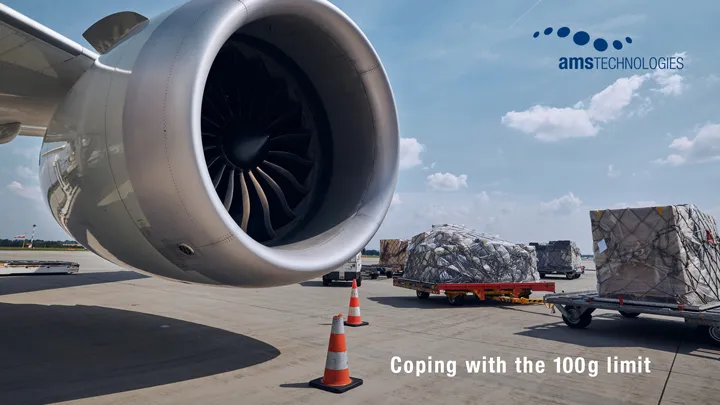
The trend for smaller capacity coolers and chillers is to move towards compressors that use hydrocarbons. Some of these compressors use isobutane, but most use propane as a refrigerant. Given that these gases are highly flammable, safety measures are necessary during production and air transportation. However, contrary to a widely held belief, air cargo transportation is not completely prohibited for devices using green refrigerants. An exception exists for devices with a maximum refrigerant filling of 100g. Consequently, the challenge for engineers lies in achieving cooling capacities of 1.5–4 kW, as required for laser cooling, with such a small amount of refrigerant gas. Due to several technical advances, the systems from AMS Technologies achieve a cooling capacity of 1,5 kW with 100 g of green refrigerant – and that is only the beginning. Chillers with 2–3 kW cooling capacity seem realistic for the future and development is already underway.
As a further challenge, such small amounts of refrigerant increase the requirements for quality control, as the tolerances for leaks the system can compensate without a decrease in performance are much tighter and they are usually operated at higher pressures. To ensure reliable function under all circumstances, every compressor circuit at AMS Technologies is subject to a helium leak test before shipping.
Conclusion
A successful cooling solution with sustainable refrigerants needs to balance many different and sometimes conflicting requirements – from performance and efficiency over packaging and weight through to safety measures and cargo restrictions.
What are your cooling needs? Contact us and our experts will listen closely to your requirements, discuss them with you and find the right solution for your project.
Read More

Cooling for Aesthetic Laser Systems: Meeting Huge Demands with Compact Solutions
Read More >
Low-to-Medium Waste Heat Recovery: Turning Industrial Waste Heat into Energy Savings
Read More >
Peltier vs. Compressor Cooling – 8 Key Considerations To Help You Make The Right Choice
Read More >FAQ: Sustainable Compressor Cooling Systems
What are green refrigerants?
Green refrigerants are gases with a low global warming potential, including natural refrigerants such as carbon dioxide, ammonia, propane, and isobutane. They reduce the climate impact associated with conventional high-GWP refrigerants.
Can an existing cooling system simply be converted to a green refrigerant?
Not usually. Refrigerants differ in operating pressure, temperature range, efficiency, flammability, and material compatibility. Switching refrigerants may therefore require changes to the compressor circuit, components, materials, controls, and safety measures.
Which compressor technologies are suitable for green refrigerants?
Reciprocating and mini rotary compressors are both available for use with selected green refrigerants. The most suitable technology depends on factors such as cooling capacity, system dimensions, noise, vibration, and operating pressure.
What safety considerations apply to cooling systems using green refrigerants?
Some natural refrigerants are flammable or corrosive. The system design must therefore account for refrigerant charge, leak tightness, component compatibility, production safety, and transport requirements.
Can compressor cooling systems using green refrigerants remain compact?
Yes. Compact compressors, microchannel condensers, and small brazed plate heat exchangers can reduce the required installation space. However, compactness must be balanced against cooling capacity, efficiency, safety, and refrigerant charge.
Can compressor cooling systems using flammable refrigerants be transported by air?
Yes. Systems containing up to 100 g of flammable refrigerant may qualify for simplified air cargo provisions. Larger refrigerant charges can also be transported, but they require additional safety precautions, documentation, packaging, and dangerous-goods handling.
EXPLORE MORE
NEWS & EVENTS
AMS Technologies and neoLASE join B2Run Hannover
B2Run Hanover 2026 was fun! Thank you to EPIC Photonics, the organizing team – and most of all to our runners from AMS Technologies and ...
Read More >

From Lab Concept to Serial Production: Addressing the PIC Polishing Challenge with KrellTech NOVA
Why repeatable component loading is the first hurdle Every polishing process depends on how reliably a chip is loaded and secured. Repeatability in loading directly ...
Read More >

AIMEN Laser Week
October 26–29, 2026
O Porriño, ES
AIMEN Laser Week is an international event dedicated to laser technologies and their applications in industrial manufacturing, process monitoring, and analytical systems. The conference combines ...
Read More >
