

 4. August 2026
 Laser reliability, proven in the field
LIGO (Laser Interferometer Gravitational-Wave Observatory) is a US-based large-scale physics experiment and observatory for the detection of cosmic gravitational waves. At two locations – Hanford, WA, and Livingston, LA – it operates some of the most sensitive measurement instruments ever built. They are designed to detect ripples in spacetime from billions of light-years away.
INSIDE LIGO’S LASER SYSTEMS
Four of our neoVAN amplifiers run as part of the pre-stabilized laser systems (PSL) inside the LIGO detectors – two in each observatory. These systems have to deliver high laser power while keeping power fluctuations, frequency drift, and beam pointing noise extremely low, because any instability in the laser affects the detector’s readings directly and can hide the signals LIGO is designed to detect. Achieving that combination of power and stability, reliably, over years of continuous operation, is what makes this application demanding.
For a detailed discussion of the PSL setup at LIGO, read the article in Galaxies 2020: Advanced LIGO Laser Systems for O3 and Future Observation Runs

FOUR YEARS, ZERO FAILURES
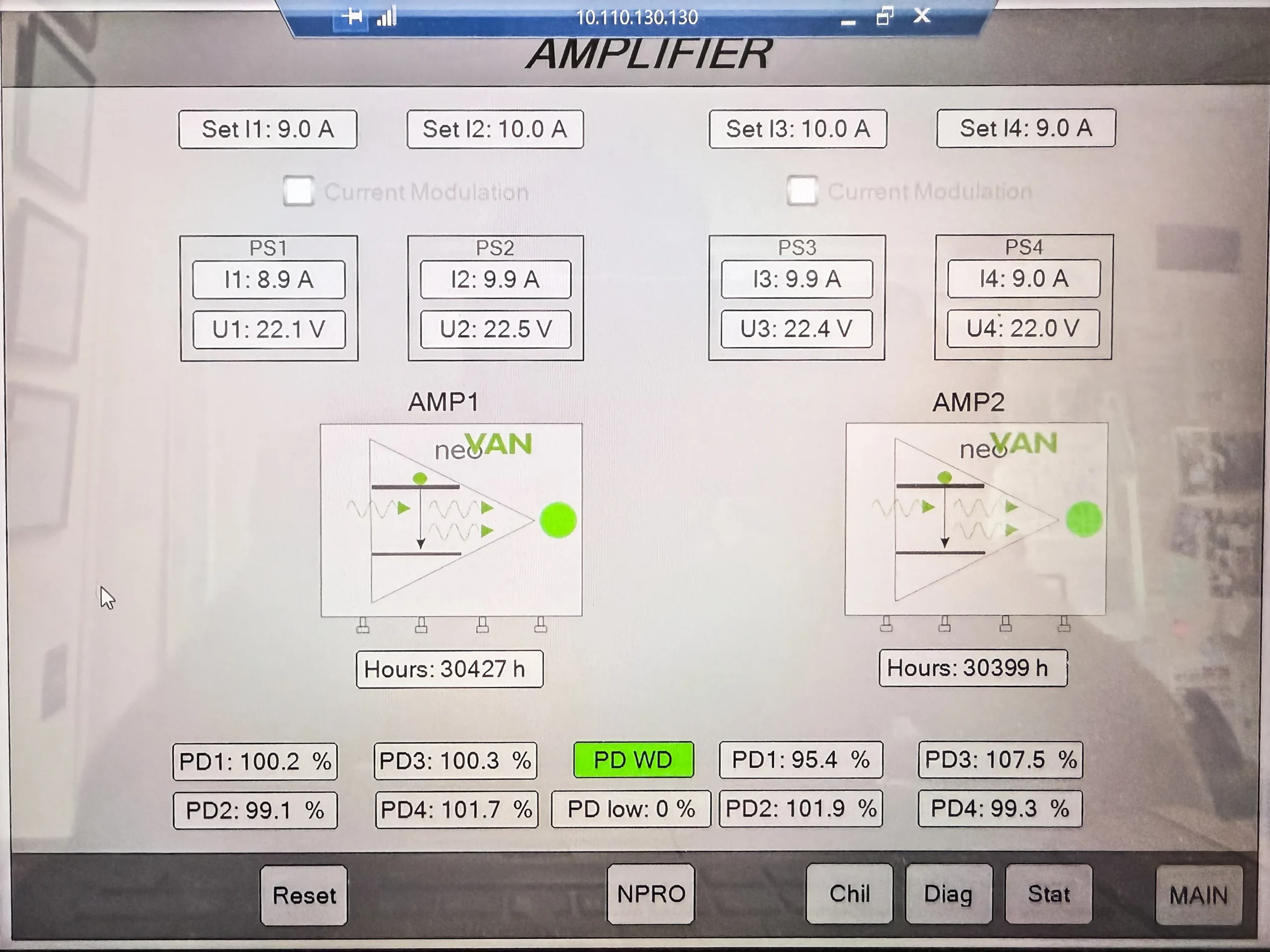
The neoVAN amplifiers have been in continuous operation since the last upgrades in 2022. At the Hanford observatory, even the diode currents are untouched since installation.
Combined operating hours now stand at 30,400 at LIGO Livingston (about 3.5 years) and 38,500 at LIGO Hanford (about 4.4 years), for over four years of uninterrupted 24/7 performance.
A TEAM EFFORT
neoLASE’s amplifiers have supported LIGO’s laser systems since the first sensitivity upgrades in 2017, with each amplifier qualified at the Albert Einstein Institute in Hannover before installation. For the current observation runs, neoLASE was chosen again as the laser source, this time also supplying the electronics that operate and control the complete system. This is what years of dedication make possible: instruments so reliable that scientists can focus on detecting ripples in spacetime, not on their laser hardware.
Congratulations to the teams at LIGO and neoLASE!

Read more about our custom laser solutions

LIBS and MOPA Lasers: More Efficiency for Aluminum Recycling
Read More >
Modular Laser Micromachining: A Scalable Platform for Precision Manufacturing
Read More >
Purity and Stability Meet High Power – 100 W Single-Frequency Laser
Read More >FAQ: Laser reliability and LIGO
What is LIGO, and what does it measure?
LIGO (Laser Interferometer Gravitational-Wave Observatory) detects gravitational waves, distortions in spacetime caused by events such as colliding black holes billions of light-years away. It operates two detector sites in the United States, in Hanford, WA, and Livingston, LA, each measuring changes in detector arm length smaller than the width of a proton.
What role do the neoVAN amplifiers play in LIGO’s laser systems?
Four neoVAN amplifiers, two per site, are part of LIGO’s pre-stabilized laser systems (PSL), which supply and stabilize the laser light for the interferometer. Two neoVAN amplifiers operate in series at each site, delivering up to 140 W before spatial filtering.
Why is this application technically demanding?
The laser system needs high output power and extremely low noise at the same time. Power fluctuations, frequency drift, or beam pointing noise couple directly into the interferometer’s readout and can mask the gravitational wave signals the detector is designed to find. Meeting both requirements simultaneously, over years of continuous operation, is what makes the application difficult.
What is the operating record so far?
Since the last upgrade in 2022, the amplifiers have run continuously at both sites, with zero failures. Combined operating hours stand at 30,400 at LIGO Livingston (about 3.5 years) and 38,500 at LIGO Hanford (about 4.4 years). At Hanford, diode currents have not required adjustment since installation.
How long has AMS Technologies (neoLASE) worked with LIGO?
The collaboration dates back to 2017, when a neoVAN amplifier module first extended LIGO’s laser system from 35 W to 80 W. Since then, neoVAN amplifiers have been upgraded across three observation run cycles, each qualified at the Albert Einstein Institute in Hannover before installation.
What is the MOPA system, and what does AMS Technologies supply?
MOPA stands for master oscillator power amplifier, the architecture used in LIGO’s current laser system: a seed laser feeding two neoVAN amplifiers in series. For the current observation runs, this configuration was selected as the laser source, and the team also supplies the electronics that operate and control the complete system.
EXPLORE MORE
NEWS & EVENTS
AMS Technologies and neoLASE join B2Run Hannover
B2Run Hanover 2026 was fun! Thank you to EPIC Photonics, the organizing team – and most of all to our runners from AMS Technologies and ...
Read More >

From Lab Concept to Serial Production: Addressing the PIC Polishing Challenge with KrellTech NOVA
Why repeatable component loading is the first hurdle Every polishing process depends on how reliably a chip is loaded and secured. Repeatability in loading directly ...
Read More >

AIMEN Laser Week
October 26–29, 2026
O Porriño, ES
AIMEN Laser Week is an international event dedicated to laser technologies and their applications in industrial manufacturing, process monitoring, and analytical systems. The conference combines ...
Read More >
